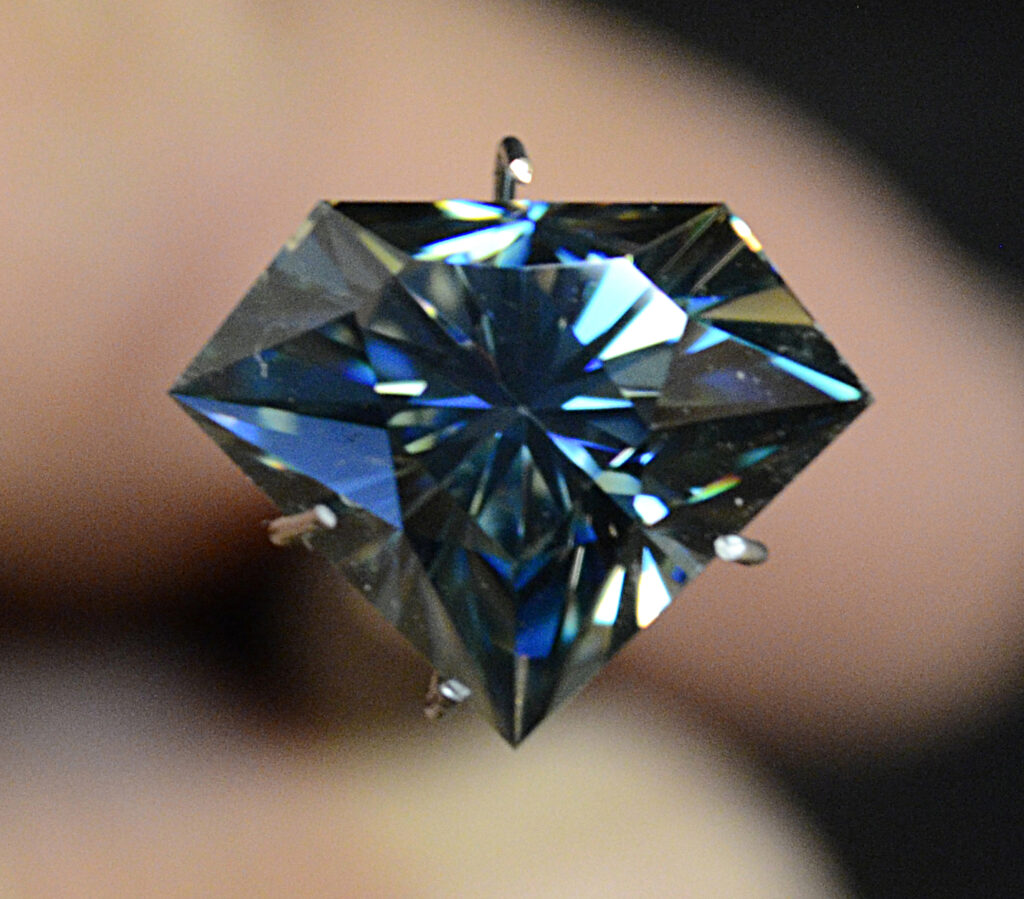
If you’ve spent any time reading about gemstones on Reddit, you’ve probably seen “precision cut” used as a synonym for American meetpoint faceting. This is understandable, since American style gems are stunning, and the cutters who work in that tradition (like me!) are meticulous. But conflating the two does a disservice to the word precision and to a lot of extraordinary cutting happening outside that tradition.
Commercial cutting prioritizes yield and speed. The goal is to get the most saleable stone out of the rough as efficiently as possible. To protect weight, cutters will sometimes work below the critical angle for a given material — the threshold at which light reflects internally rather than leaking out through the bottom. When that happens, you get windowing: a washed-out zone through the table where you see straight through the stone rather than reflected light and color. Meetpoints may be slightly off, polish adequate rather than exceptional, proportions driven by the rough rather than the optics of the finished gem. There are plenty of those posted to this subreddit, you won’t need to look far.
American meetpoint faceting is a specific design methodology developed in the mid-20th century. It optimizes facet angles and geometry so that every junction meets exactly, prioritizing light return and optical performance for the material being cut. It’s a rigorous and beautiful style, but it is one approach among several. There are some posted here daily, and lots posted to places like the faceting or Shinypreciousgems subreddits.
Precision cutting is a standard of execution, not a style. It means the stone was cut for maximum optical performance, meetpoints are clean and exact, the polish is exceptional, and the stone is symmetrical. That last point deserves more attention than it usually gets. As an example of a precision cut with rounded girdles, here is a cushion-cut tanzanite by Victoria Reynaud with amazing polish and precision, no windowing, and rounded girdles.
Symmetry is one of the hardest things to achieve in faceting, and one of the clearest indicators of skill. On faceted stones with a defined girdle edge and girdle meetpoints, the cutter has reference landmarks to work from. Those junctions provide alignment guides throughout the cutting process. Remove them, and the job gets significantly harder. Traditional rounded girdle cuts like cushions and ovals have a curved girdle with no meetpoints along the edge, which means fewer fixed reference points to check symmetry against. Getting the corners of a cushion cut to land in exactly the right place, balanced and even on all sides, is genuinely impressive work. It comes down entirely to the cutter’s skill and judgment.
A precision-cut stone could be American meetpoint, a perfectly executed traditional brilliant from a Thai cutter working at the highest level, or a piece from the French lapidary tradition. The word describes how well the work was done, not which methodology was followed.
When evaluating a stone, the right questions are: Do the facets meet cleanly? Is the polish free of scratches and pitting? Does light behave the way it should for that material and cut style? Is there windowing? Is the outline symmetrical, and do the corners sit where they should? Those are precision questions. The style is a separate conversation.